Wealthy Pot
Options Trading 101: Calls, Puts, and Strategies
Introduction
Options trading is a powerful and versatile way to participate in financial markets, offering unique benefits such as leverage, flexibility, and risk management. Although options can be more complex than traditional stock trading, understanding the basics of calls, puts, and various options strategies can open the door to new possibilities in your portfolio. In this comprehensive guide, you will learn:
- The fundamental definitions and mechanics behind options.
- How calls and puts work, with real-world examples.
- Basic to advanced strategies, including covered calls and spreads.
- Key principles of risk management to help protect your capital.
By the end of this article, you will have an in-depth understanding of options trading essentials, and be ready to explore further resources for honing your skills.
Disclaimer: Options are complex, high-risk instruments and are not suitable for everyone. As an options buyer, you can lose 100% of the premium you pay, often quickly, if the trade moves against you. As an options seller, your losses can be far larger than the premium you collect: selling a naked (uncovered) call carries theoretically unlimited loss potential. Leverage magnifies losses as well as gains. Only trade with money you can afford to lose entirely, never core savings or retirement funds you can't do without. This article is educational, not personalized investment advice; do your own due diligence, consider consulting a licensed financial advisor, and review official sources such as the U.S. Securities and Exchange Commission (SEC) before trading options.
What Are Options?
An option is a contract that grants its holder the right, but not the obligation, to buy or sell an underlying asset (often a stock) at a predetermined price (known as the strike price) on or before a specific date (the expiration date). The buyer pays a premium to the seller (writer) of the option for that right. Each option typically controls 100 shares of the underlying stock, though there can be exceptions.
Options fall into two primary categories: Call options and Put options. Understanding these two building blocks is the first step toward mastering options trading.
Key Terms in Options Trading
- Underlying asset: The financial instrument on which an options contract is based (e.g., stocks, ETFs, indexes).
- Strike price: The agreed-upon price at which the holder can exercise the option.
- Premium: The cost the buyer pays for the option contract. This premium fluctuates based on factors such as time until expiration, underlying asset price, and implied volatility.
- Expiration date: The date by which the option must be exercised (for American-style options) or on which the option is automatically settled (for European-style options).
- Exercise: The action of buying (for a call) or selling (for a put) the underlying asset at the strike price.
- Assignment: The obligation of the option seller (writer) to deliver or purchase shares if the buyer exercises the option.
The Mechanics of Calls
A call option grants its holder the right, but not the obligation, to buy the underlying asset at the strike price.
- Buyer’s Perspective: The call buyer anticipates the underlying asset’s price will rise. If the asset price goes above the strike price, the holder can buy shares at a discount compared to the market value.
- Seller’s (Writer’s) Perspective: The seller receives the premium from the buyer. If the underlying asset stays below or near the strike price, the call writer profits from the premium. If the stock price surges above the strike price, the writer must deliver shares at the strike price if assigned, potentially missing out on gains.
Call Option Example

Imagine a stock currently trading at $100 per share. You purchase a call option with:
- Strike price = $105
- Premium = $2 per share
- Expiration date = 1 month from now
You pay $2 * 100 shares = $200 total for this option contract.
- If the stock rises above $105 (say to $110):
- You can exercise the option, buy the shares at $105 each, and potentially sell them in the market at $110 each, realizing a profit.
- The profit on the stock side would be $5 per share. Considering you paid $2 premium, your net gain is $3 per share ($5 – $2).
- If the stock stays below $105:
- Exercising the call option makes no sense because the market price is cheaper than $105.
- The option could expire worthless, and your loss is limited to the $200 premium you initially paid.
Hence, buying a call gives you upside exposure with limited downside (the premium).
The Mechanics of Puts
A put option grants its holder the right, but not the obligation, to sell the underlying asset at the strike price.
- Buyer’s Perspective: The put buyer may be bearish (expecting the underlying asset’s price to drop) or seeking protection. If the stock price falls below the strike price, the put holder can sell shares at that higher strike price.
- Seller’s (Writer’s) Perspective: The put writer believes the underlying asset will remain above the strike price, profiting from the premium. If assigned, the writer must buy shares at the strike price, potentially incurring a loss if the market price is far lower.
Put Option Example

Consider a stock at $100 per share. You buy a put option with:
- Strike price = $95
- Premium = $3 per share
- Expiration date = 1 month from now
You pay $3 * 100 shares = $300 total for this option contract.
- If the stock drops to $90:
- You can exercise your right to sell at $95, even though the market price is $90.
- The intrinsic value is $5 per share (95 – 90). Subtract your $3 premium, and your net gain is $2 per share ($5 – $3).
- If the stock stays above $95:
- Selling at $95 makes no sense if the market price is higher.
- Your put may expire worthless, and you lose the premium ($300).
Thus, owning a put can hedge your portfolio or allow you to speculate on downward price movements with limited risk (the premium paid).
Understanding Option Premiums: Time Value and Intrinsic Value
The premium you pay or receive for an option depends on two primary components:
- Intrinsic Value: The difference between the underlying asset price and the strike price if the option is in-the-money.
- Time Value: The additional value associated with the time left until expiration and the expected volatility. Options with longer durations and higher implied volatility will typically carry a higher time value.
For example, a call with a strike price below the current stock price (i.e., in-the-money) has intrinsic value. But options also have time value that decays as expiration nears. This phenomenon is often referred to as theta decay, a key factor for short-term traders.
Option Premium Calculator
<button onclick='calculatePremium()' style="padding: 10px 20px; border: none; border-radius: 5px; background: #28a745; color: white; font-size: 16px; cursor: pointer; margin-top: 15px; width: 100%;">Calculate Premium</button>
<p id='premiumResult' style="margin-top: 15px; font-weight: bold; font-size: 14px;"></p>

<h3 style="font-size: 1.4rem; text-align: center; color: #000; font-weight: bold; margin-top: 20px;">Option Chain Table</h3>
<button onclick='generateOptionChain()' style="padding: 10px 20px; border: none; border-radius: 5px; background: #28a745; color: white; font-size: 16px; cursor: pointer; margin-top: 10px; width: 100%;">Generate Option Chain</button>
<table id='optionChain' style="width: 100%; border-collapse: collapse; margin-top: 10px;">
    <thead>
        <tr>
            <th style="border: 1px solid #ccc; padding: 8px;">Strike Price</th>
            <th style="border: 1px solid #ccc; padding: 8px;">Call Price</th>
            <th style="border: 1px solid #ccc; padding: 8px;">Put Price</th>
        </tr>
    </thead>
    <tbody></tbody>
</table>
Why Trade Options?
- Leverage: By paying a relatively small premium, you can control a larger position in the underlying stock.
- Risk Management / Hedging: Puts can serve as insurance for a stock portfolio, while certain call strategies can limit downside.
- Income Generation: Writing (selling) options can generate income in the form of option premiums, as long as you’re prepared for potential assignment.
- Flexibility: You can use multiple combinations of calls and puts to craft specific risk/reward profiles.
Basic Options Strategies
1. Long Call
- Objective: Profit from an anticipated rise in the underlying stock price.
- Risk: Limited to the premium paid.
- Reward: Potentially unlimited gains if the stock price soars.
- When to Use: You expect a significant upward price move but want to cap your potential loss.
2. Long Put
- Objective: Profit from a drop in the underlying stock price or hedge existing long stock positions.
- Risk: Limited to the premium paid.
- Reward: Potentially significant gains if the stock price falls sharply.
- When to Use: You expect a downward move or want protection against a market decline.
3. Covered Call
- Mechanics: You own shares of a stock and then sell (write) a call option against those shares.
- Objective: Generate income (the premium) on shares you already hold.
- Risk: If the stock’s price rises substantially above the strike, your shares may be called away, capping your upside.
- Reward: Income from the premium plus potential appreciation up to the strike price.
- When to Use: You have a moderately bullish or neutral view on the stock and want extra income.
Covered Call Example
- You own 100 shares at $100 each.
- You sell one call with a $105 strike for $2 premium.
- If the stock remains below $105, you keep your shares plus the $2 premium.
- If the stock rises above $105, you might have to sell at $105, but still keep the premium.
4. Protective Put
- Mechanics: You own a stock and buy a put option on it.
- Objective: Hedge downside risk by ensuring you can sell shares at the put’s strike price if the stock tumbles.
- Risk: The cost of the put premium.
- Reward: If the stock falls, the put gains value, offsetting losses on the shares.
- When to Use: You’re bullish on a stock but want a safety net against significant declines.
Intermediate Options Strategies
5. Vertical Spreads (Bull Call Spread, Bear Put Spread)
A spread involves buying and selling the same type of option (calls or puts) with the same expiration but different strike prices. This can reduce overall cost and risk compared to a simple long option position but also caps potential gains.
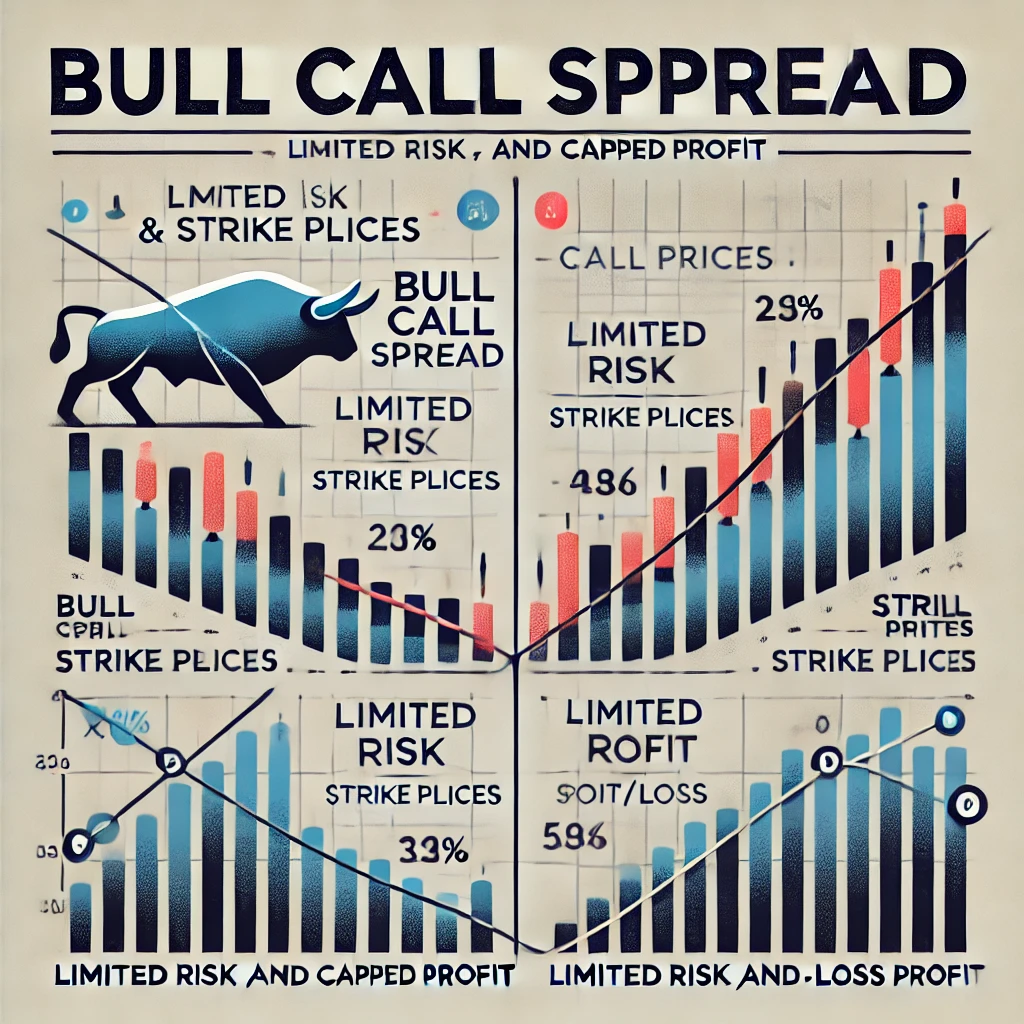
- Bull Call Spread: Buy a call at a lower strike, sell a call at a higher strike.
- Outcome: You profit if the stock rises but your gains are capped at the higher strike. Your net cost is lower than a simple long call.
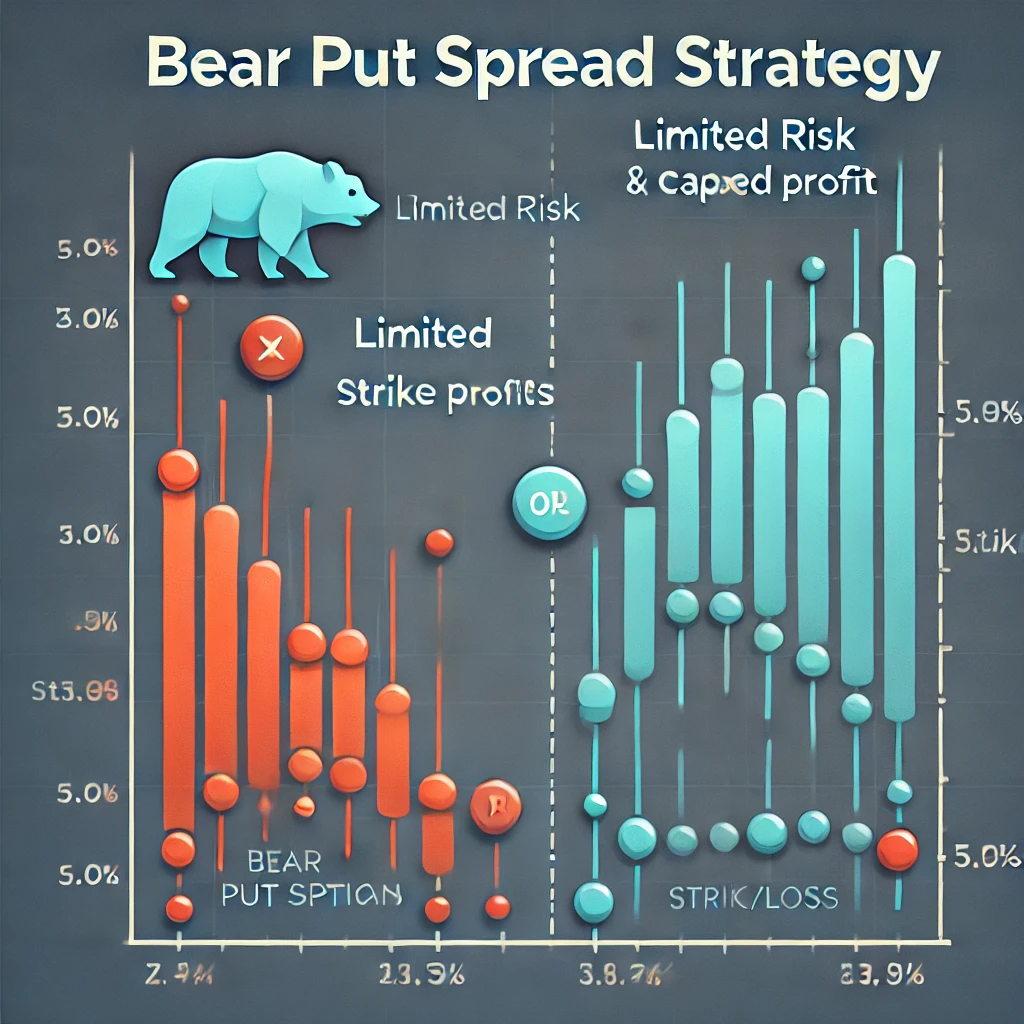
- Bear Put Spread: Buy a put at a higher strike, sell a put at a lower strike.
- Outcome: You profit if the stock declines, but your total gain is capped at the lower strike. You pay a smaller net premium than a simple long put.
6. Iron Condors
An iron condor is a neutral strategy using four options: two calls and two puts at different strikes. You receive a net credit if you sell the inner strikes and buy the outer strikes. The goal is for the underlying to remain within a relatively narrow price range. This strategy takes advantage of time decay if the price stays stable.
- Risk: Limited to the difference between strikes minus the net credit.
- Reward: Limited to the net credit received.
- When to Use: You expect minimal price movement in the underlying over the life of the options.
7. Straddles and Strangles
If you expect a large move in the stock but are unsure of the direction, you can buy both a call and a put:
- Long Straddle: Buy a call and put at the same strike price.
- Long Strangle: Buy a call and put at different strike prices (usually out-of-the-money).
You profit if the underlying moves significantly in either direction. However, if the market remains flat, both options may lose significant value, and you incur a net loss (the total premiums).
Mind the breakeven. A straddle only pays off if the move is bigger than the combined premiums, not just any move. If you pay $5 for the call and $5 for the put on a $100 stock ($10 total), you don't break even until the stock reaches $110 or falls to $90; a move to only $105 or $95 still loses money. Because you're paying for two options, a modest 3–5% wiggle around earnings often falls short of breakeven, a common way beginners lose on straddles.
8. Butterfly and Calendar Spreads
Two more defined-risk strategies that build on spreads:
- Butterfly Spread: A neutral, limited-risk strategy built from three strikes of the same option type, buy one in-the-money, sell two at-the-money, and buy one out-of-the-money (a 1-2-1 structure). It profits most if the underlying finishes right at the middle strike at expiration. Maximum loss is limited to the net cost to open the position.
- Calendar Spread (Time Spread): You sell a near-term option and buy a longer-dated option at the same strike. The idea is to profit from the faster time decay of the near-term option while keeping longer-term exposure. It works best when the underlying stays near the strike in the short run, and it's sensitive to changes in implied volatility.
Advanced Strategies and Option Greeks
As you become more advanced, you might incorporate option Greeks, mathematical measures that help you gauge how an option’s price will move given changes in underlying price, volatility, and time.
- Delta: Sensitivity of the option price to a $1 change in the underlying asset.
- Gamma: The rate of change of Delta.
- Theta: Time decay (the amount the option loses in value each day, all else being equal).
- Vega: Sensitivity to changes in implied volatility.
- Rho: Sensitivity to changes in interest rates.
By understanding these Greeks, you can refine your strategy to match your market outlook. For instance, if you want to profit from time decay, you might implement credit spreads or iron condors. If you want to benefit from high volatility expectations, you might buy straddles or strangles. As a concrete example of Delta: an option with a Delta of 0.50 will gain roughly $0.50 in value for every $1 the underlying stock rises (and lose about that much if it falls).
Naked (Uncovered) Options: The Highest-Risk Play
Selling an option without holding an offsetting position, known as writing "naked" or uncovered options, is among the riskiest things you can do in a brokerage account, and it deserves its own warning:
- Naked call: If you sell a call and don't own the underlying shares, your loss is theoretically unlimited, because a stock can keep rising with no ceiling, and you'd have to deliver shares at the strike no matter how high the price climbs.
- Naked put: Your loss is capped only by the stock falling to zero, so the maximum loss is the strike price minus the premium collected, potentially a very large sum.
Because of this, brokers require a high options-approval level and substantial margin to sell naked options. For most investors, these strategies are best avoided entirely; defined-risk alternatives like spreads achieve similar aims without the open-ended downside.
Risk Management in Options Trading
Options are inherently risky. However, you can mitigate or control risk in several ways:
- Position Sizing: Allocate only a portion of your overall capital to options trades.
- Setting Stop-Loss or Profit Targets: Although slippage can occur, especially with fast-moving markets or illiquid options, having an exit plan helps remove emotion from decision-making.
- Hedging: Combine positions (e.g., protective puts or collars) to limit large losses.
- Volatility Considerations: Implied volatility can inflate option premiums. Some traders prefer to sell options when volatility is high, but that strategy carries the risk of large moves.
- Avoid Over-Leverage: While leverage can boost returns, it can also magnify losses.
- Stay Informed: Economic reports, earnings announcements, and Federal Reserve decisions can drastically affect stock and option prices.
Authoritative Resource: Review the Chicago Board Options Exchange (CBOE) guides on risk management for advanced best practices.
Practical Table: Calls vs. Puts
Below is a brief table summarizing key differences between calls and puts:
| Aspect | Calloptions | Putoptions |
|---|---|---|
| Right Granted | Buy underlying at strike price | Sell underlying at strike price |
| Buyer’s Market Outlook | Bullish or anticipating upward movement | Bearish or anticipating downward movement |
| Seller’s Obligation | Provide the underlying shares if assigned | Purchase the underlying shares if assigned |
| Max Profit (Buyer) | Theoretically unlimited | Strike Price - Premium (if price goes to 0) |
| Max Loss (Buyer) | Premium paid | Premium paid |
| Typical Use Cases | Upside speculation, leverage, covered calls | Downside speculation, hedging, protective puts |
Common Mistakes to Avoid
- Ignoring Time Decay: For buyers, every day that passes decreases option value if the underlying isn’t moving in your favor.
- Misunderstanding Volatility: High implied volatility means higher premiums. If volatility drops, your option could lose value even if the underlying moves in the expected direction.
- Lack of Exit Strategy: Without a plan to lock in profits or cut losses, emotions can lead to poor decisions.
- Over-Leveraging: Placing too large a bet on short-dated, out-of-the-money options can result in quick, total losses.
- Failing to Review Early Assignment Risk: American-style options can be exercised anytime. Be prepared for potential early assignment if you write in-the-money options.
Conclusion
Options trading can be a highly effective tool for both speculation and risk management. By mastering the foundational concepts, calls, puts, strike prices, premiums, and then progressing through basic, intermediate, and advanced strategies, you can build a comprehensive toolkit to handle the markets.
The keys to success in options trading include:
- Thorough education and continual learning.
- Strong risk management discipline.
- Successful options trading relies on real-world examples, learning from authoritative sources, and maintaining discipline through well-researched strategies.
If you approach options with patience, discipline, and a willingness to learn from both successes and mistakes, you stand a better chance of reaching the potential these versatile financial instruments offer.
Authoritative Sources & Further Reading: