
Exchange-Traded Fund (ETF): A Comprehensive Glossary & Guide

Introduction
An Exchange-Traded Fund (ETF) is an investment product that has revolutionized how individuals and institutions participate in financial markets. By bundling multiple underlying assets into a single investment vehicle and listing it on a stock exchange, an ETF makes diversification simpler and more cost-effective. It also offers the convenience of intraday trading, much like a stock.
ETFs have evolved significantly since their introduction in the early 1990s. Today, you’ll find ETFs tracking everything from the broad U.S. stock market (like the S&P 500) and corporate bond indexes to narrow sectors such as technology or biotech, as well as commodities like gold and oil. There are even ETFs that provide exposure to cryptocurrencies (e.g., Bitcoin or Ethereum), various international markets, and specialized investment strategies. According to the U.S. Securities and Exchange Commission (SEC), ETFs in the United States must be registered under the Investment Company Act of 1940, with additional rules tailored specifically for these instruments to ensure transparency and investor protection.
In this comprehensive guide, we will:
- Provide a glossary of essential ETF-related terms.
- Explore the mechanics of how ETFs are created and traded.
- Discuss various types of ETFs available, including passive, active, sector, bond, commodity, leveraged, and even crypto ETFs.
- Lay out the pros and cons.
- Compare ETFs with mutual funds and individual stocks.
- Cover critical considerations like dividends, taxes, and trading costs.
- Offer a step-by-step guide on how to start investing in ETFs.
- Address international aspects, such as how ETFs operate in the United Kingdom.
- Conclude with best practices and frequently asked questions (FAQ).
By the end, you’ll have a deep understanding of what ETFs are, how they can fit into a broader portfolio, and what specific details to watch for before investing. Once you hold a few, a portfolio tracker helps you see your true asset mix across every account in one place.
1. Glossary of Essential ETF Terms
- Exchange-Traded Fund (ETF): A basket of securities (stocks, bonds, commodities, or derivatives) that trades on an exchange throughout the day, much like a single stock.
- Underlying Assets: The collection of stocks, bonds, or other securities that an ETF holds. For instance, an S&P 500 ETF holds shares of the 500 companies in that index.
- Net Asset Value (NAV): The total value of an ETF’s assets (minus liabilities) divided by the number of outstanding shares. While mutual funds transact at their daily NAV, an ETF’s trading price can fluctuate around the NAV during market hours.
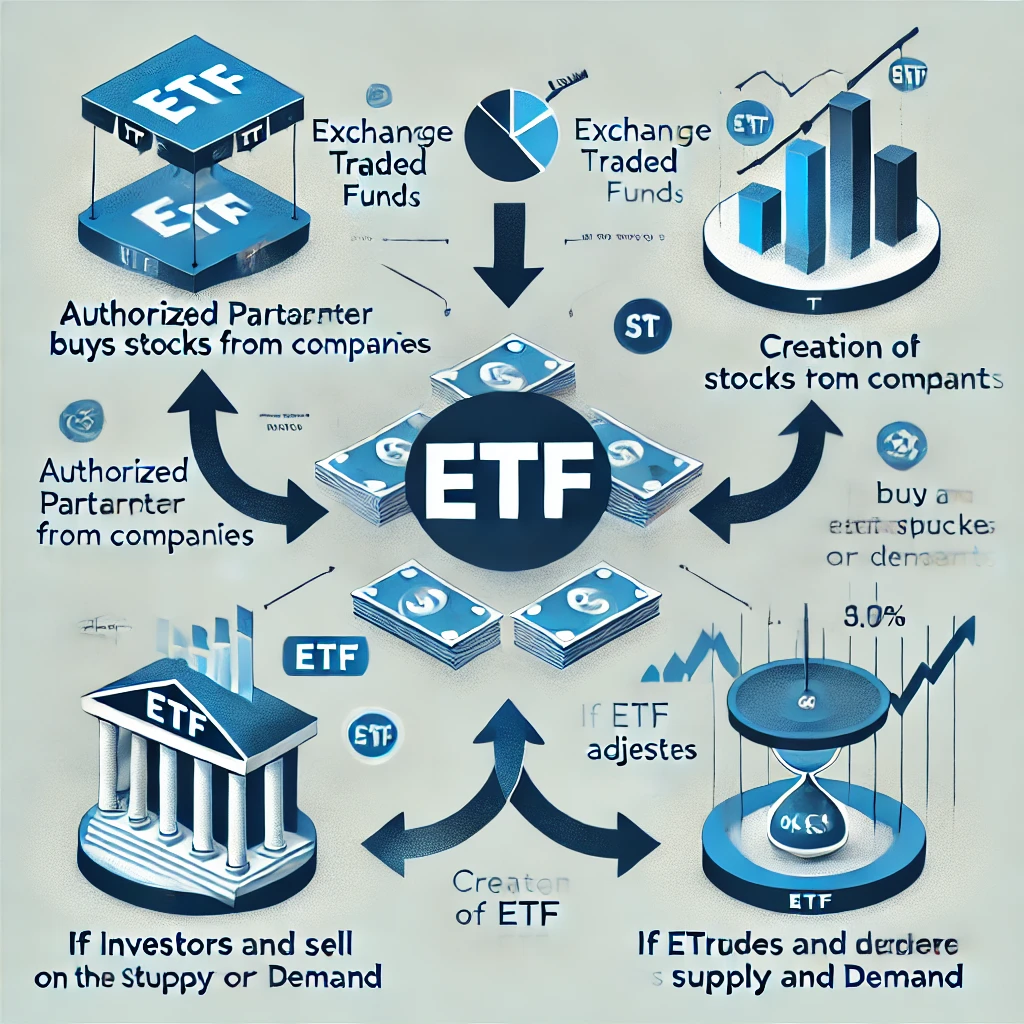
- Creation and Redemption: The process by which ETF shares are created or removed from the market. Authorized participants (APs), often large financial institutions, gather (or distribute) the underlying assets to match the ETF’s composition in exchange for newly created (or redeemed) ETF shares.
- Authorized Participant (AP): A specialized entity, typically a large bank or financial institution, that plays a central role in the creation/redemption process to help maintain an ETF’s market price in line with its NAV.
- Bid-Ask Spread: The difference between the highest price buyers are willing to pay (bid) and the lowest price sellers are willing to accept (ask). Wider spreads can raise trading costs.
- Expense Ratio: The annual fee charged by the ETF, covering management and operating expenses. Lower ratios are generally preferable, especially for long-term investors.
- Tracking Error: The difference between an ETF’s performance and that of its benchmark index or target strategy. Small tracking errors are common, but large discrepancies can signal fund inefficiency.
- Spot ETF (Crypto): An ETF holding the actual underlying cryptocurrency (e.g., Bitcoin or Ethereum) rather than using futures contracts. Approved in certain jurisdictions starting in 2024.
2. The Mechanics of ETFs: How They Work
2.1 Intraday Trading
Unlike mutual funds, which can only be bought or sold at the day’s closing price, ETFs can be traded whenever the stock market is open. Their prices fluctuate throughout the trading day based on supply and demand, as well as changes in the value of their underlying assets.
- Advantage: Investors can react more quickly to market developments (e.g., economic data, news events).
- Risk: Intraday trading can encourage short-term speculation, which may lead to higher trading costs and potential misalignment with long-term goals.
2.2 The Creation and Redemption Process
A defining feature of ETFs is how shares enter and exit the market:
- Creation
- An authorized participant assembles a basket of assets mirroring the ETF’s targeted composition.
- These assets are delivered to the ETF sponsor in exchange for a “creation unit,” which is a large block of ETF shares (often 50,000 shares or more).
- The AP then sells these ETF shares on the open market to individual or institutional investors.
- Redemption
- The reverse happens if ETF shares need to be taken out of circulation.
- The AP buys shares of the ETF from the market and returns them to the ETF sponsor in exchange for the equivalent basket of underlying securities.
- The redeemed ETF shares are effectively retired from circulation.
Through this mechanism, arbitrage opportunities (buying undervalued shares or selling overvalued ones) help keep an ETF’s market price close to its NAV. For instance, if an ETF trades at a premium above its NAV, an AP can create new ETF shares (buying the cheaper underlying assets), then sell these ETF shares at a higher market price, thus pushing the ETF price back toward its NAV.
2.3 Regulation and Oversight
In the U.S., ETFs are generally subject to:
- The Investment Company Act of 1940
- Oversight from the Securities and Exchange Commission (SEC)
Other countries have equivalent structures. In Europe, ETFs must often comply with UCITS (Undertakings for Collective Investment in Transferable Securities) regulations, ensuring standardized protections for investors in EU member states.
3. Types of ETFs
ETFs come in diverse varieties, each designed to meet different investment goals, risk appetites, or market outlooks. Below are some of the most popular types. One product that is easy to confuse with an ETF is the exchange-traded note, which is a bank debt obligation rather than a basket of holdings and therefore carries issuer credit risk. We break that distinction down in ETN vs ETF: the key differences. If you are weighing an ETF against a traditional fund instead, see mutual funds vs ETFs.
3.1 Passive (Index) ETFs
- Definition: Track a specific index, like the S&P 500 or the Russell 2000, by holding all or a representative sample of the securities in that index.
- Benefits: Typically low expense ratios, minimal turnover, and stable exposure to broad market segments.
- Examples:
- SPDR S&P 500 ETF (SPY), the first major U.S. ETF, launched in 1993.
- Vanguard Total Stock Market ETF (VTI), covering nearly all U.S.-listed equities.
3.2 Actively Managed ETFs
- Definition: A portfolio manager or team actively selects and rebalances holdings to outperform a benchmark.
- Pros: Potential for higher returns and more flexibility in response to market conditions.
- Cons: Higher expense ratios and the possibility of underperformance relative to passive benchmarks.
3.3 Bond ETFs
- Definition: Invest primarily in government bonds, corporate bonds, or municipal bonds. Some bond ETFs target broad bond indexes, while others specialize in specific maturities or credit qualities.
- Use Case: Income generation and portfolio diversification. Often considered lower-volatility holdings compared to many equity ETFs, but interest-rate risk can still impact performance.
3.4 Sector or Industry ETFs
- Definition: Focus on specific sectors (e.g., technology, healthcare, energy) or industries (e.g., gold mining, electric vehicles).
- Benefit: Allows targeted exposure to sectors with strong growth or cyclical potential.
- Risk: Concentrated holdings may result in higher volatility than broad-based funds.
Each major sector has well-known, low-cost ETFs. The table below shows why investors reach for each one, and the risk that comes with concentrating in a single slice of the market:
| Sector | Example ETFs | Why investors buy it | Main risk |
|---|---|---|---|
| Technology | XLK, QQQ | Growth and innovation exposure | Top-heavy in a few mega-caps; volatile |
| Healthcare | XLV, IBB | Defensive, with demographic tailwinds | Regulatory and patent risk |
| Energy | XLE, TAN | Inflation hedge, commodity upside | Highly cyclical; swings with commodity prices |
| Financials | XLF, KBE | Tend to benefit from higher interest rates | Sensitive to credit cycles and recessions |
| Consumer Discretionary | XLY, PEJ | Rides consumer and economic expansion | Falls hard in downturns |
Because a sector fund deliberately drops broad diversification, the top few holdings can dominate it (a technology ETF, for example, may lean heavily on a handful of mega-caps). A common way to use them without over-betting is a core-satellite approach: hold a broad-market ETF as your core and add a smaller sector "satellite" (often 10–20% of the portfolio) rather than concentrating in one industry. Favor sector ETFs with expense ratios under about 0.5%, and check the top holdings so you know how concentrated the fund really is.
3.5 Commodity ETFs
- Definition: Track underlying commodities like gold, oil, natural gas, or agriculture.
- Purpose: Provide investors with a more convenient way to gain exposure to commodities without handling physical goods or dealing with commodity futures directly.
3.6 Currency ETFs
- Definition: Reflect the value of specific currencies or currency pairs.
- Usage: Traders and investors use currency ETFs to hedge foreign exchange risk or to speculate on currency movements.
3.7 Inverse and Leveraged ETFs
- Inverse ETFs: Designed to profit when an underlying index falls in value. Often use derivatives to replicate the short exposure.
- Leveraged ETFs: Aim to multiply the daily returns (2×, 3×) of an index or sector.
- Note: Both are generally best suited for advanced traders or very short-term strategies, because compounding effects can create unexpected performance outcomes over longer periods.
3.8 Cryptocurrency ETFs
- Bitcoin ETFs: The spot Bitcoin ETF, approved in some regions in 2024, directly holds bitcoin as the underlying asset. Bitcoin futures ETFs, approved earlier in some jurisdictions, track the price of bitcoin futures contracts instead.
- Ethereum ETFs: Spot ether ETFs similarly hold ether; U.S. spot ether ETFs began trading in July 2024.
- Consideration: Crypto ETFs can be more volatile due to the inherent price swings of digital assets.
4. Key Features of an ETF: Pros and Cons
Below is a concise table summarizing the primary features of ETFs, along with their pros and cons.
| Feature | Pros | Cons |
|---|---|---|
| Intraday Liquidity | Buy\/sell throughout the trading day; real-time price updates | Frequent trading can increase costs; prices can be volatile in illiquid ETFs |
| Cost Efficiency | Lower expense ratios than many mutual funds; commission-free trading on some platforms | Bid-ask spreads may offset savings; some active or niche ETFs can be more expensive |
| Tax Advantages | Creation\/redemption process often reduces capital gains distributions | Taxable upon sale of ETF shares; not all ETFs are equally tax-efficient |
| Transparency | Daily disclosure of holdings for most ETFs; easier to monitor portfolio composition | Actively managed ETFs may have less frequent or partial disclosure |
| Portfolio Customization | Variety of sectors, asset classes, strategies available | Over-diversification can lead to diluted returns |
| Diversification | Exposure to multiple assets within one fund; reduces single-stock concentration | Sector-specific or thematic ETFs can still have high concentration risk |
5. Comparing ETFs to Mutual Funds and Stocks
Many of the benefits and drawbacks of ETFs become clearer when you compare them directly to mutual funds and individual stocks.
5.1 ETFs vs. Mutual Funds
- Trading Times:
- ETFs trade intraday; mutual funds are bought/sold at the day’s closing NAV.
- Costs:
- Many mutual funds have higher expense ratios, plus possible front-end or back-end sales loads.
- ETFs often have lower annual costs, but watch out for brokerage commissions (if applicable) and bid-ask spreads.
- Tax Efficiency:
- ETFs typically make fewer capital gains distributions due to the in-kind redemption mechanism.
- Mutual funds often distribute capital gains each year if there’s portfolio turnover.
5.2 ETFs vs. Stocks
- Diversification:
- One ETF share can represent hundreds (or thousands) of underlying holdings, spreading risk.
- A single stock leaves you exposed to that company’s specific business performance.
- Flexibility:
- Both ETFs and stocks offer intraday trading.
- ETF performance depends on multiple companies or assets, whereas a stock’s price is driven by one company’s fortunes.
- Fees:
- Owning a stock directly has no management fee.
- ETFs have an annual expense ratio but reduce risk by diversifying across multiple holdings.
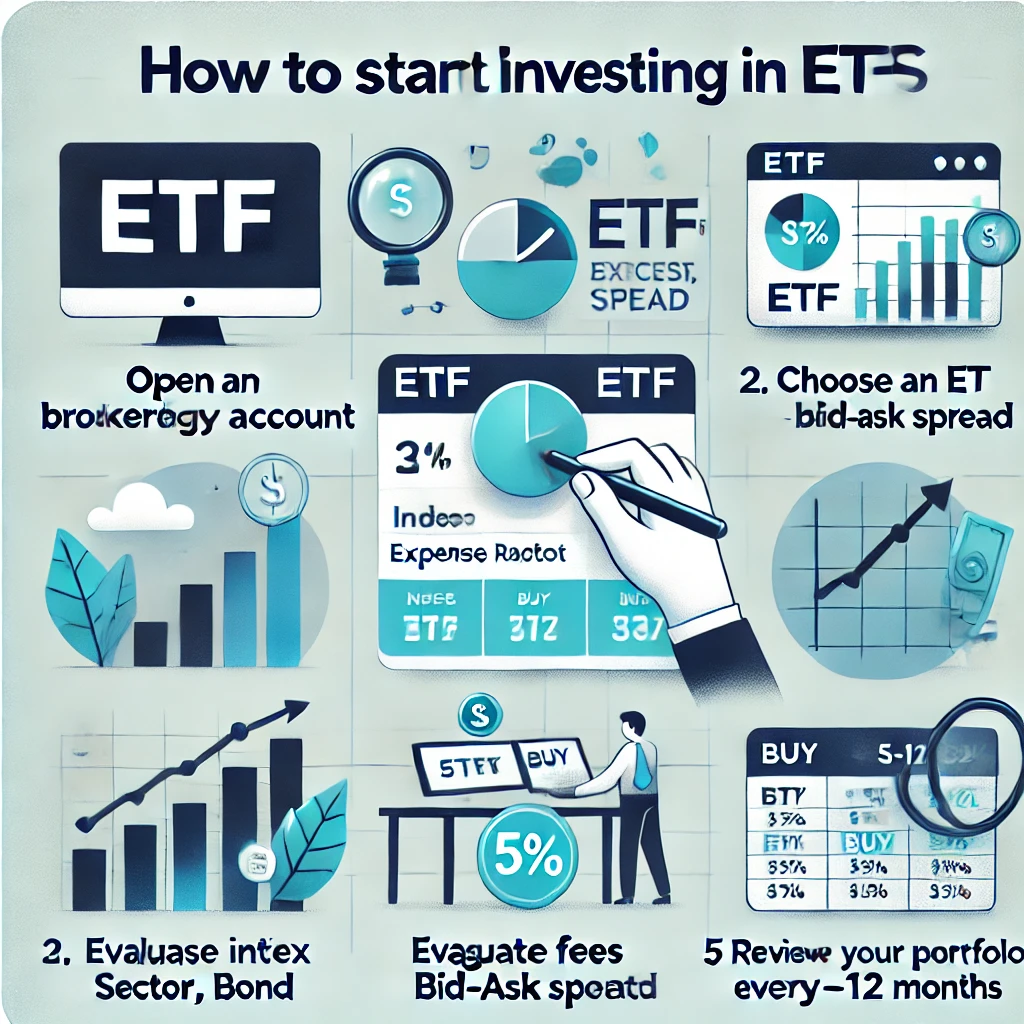
6. How to Invest in an ETF: Step-by-Step
If you’ve decided ETFs might suit your goals, here’s a simple roadmap to get started:
- Choose a Brokerage
- Look for a platform that offers commission-free ETF trades, user-friendly research tools, and strong customer support. Examples include Fidelity, Charles Schwab, E*TRADE, and others.
- Open and Fund Your Account
- This might involve linking a bank account, transferring from another broker, or rolling over an existing retirement account (e.g., 401(k) or IRA).
- Research ETF Options
- Index or Sector? If you want broad market exposure, an S&P 500 or total-market ETF might be ideal. If you have strong convictions on a particular industry, a sector ETF could align better.
- Expense Ratio: Even a small difference (e.g., 0.04% vs. 0.15%) can impact long-term returns.
- Trading Volume: Higher volumes generally mean tighter bid-ask spreads and easier trade execution.
- Portfolio Fit: Ensure the ETF complements your existing holdings and risk tolerance.
- Place an Order
- You can buy an ETF using a market order (executes immediately at the prevailing price) or a limit order (executes only if the price meets or beats your limit).
- Consider the bid-ask spread to avoid overpaying, especially for thinly traded or niche ETFs.
- Monitor and Rebalance
- Over time, your asset allocation may shift as certain ETFs appreciate or decline in value relative to others. Periodic rebalancing helps maintain your target risk level.
- Many long-term investors practice “buy-and-hold” and only rebalance once or twice a year.
- Stay Informed
- Keep an eye on distribution schedules, changes to underlying indexes, and any announcements about the fund’s expense ratio, leadership, or strategy.
A simple starter example. If you had $1,000 to build a first ETF portfolio, one beginner-friendly, broadly diversified split might look like this (illustrative, not a recommendation): $400 in a total-market or S&P 500 ETF (e.g., VTI or SPY), $200 in a bond ETF (e.g., BND) for ballast, $200 in an international ETF (e.g., VWO) for global exposure, and $100 each in a sector and a thematic ETF (e.g., XLK and ARKK) for a bit of growth tilt. The exact funds matter less than the shape: a broad core, some bonds, and only a small slice in narrower bets. Rebalance back to your targets once or twice a year.
7. Dividends, Taxes, and Other Key Considerations
7.1 Dividends
- Dividend-Paying ETFs: Some ETFs hold dividend-paying stocks or coupon-paying bonds. Dividends (or coupons) are typically passed on to ETF shareholders.
- Dividend Reinvestment: Many brokerages let you automatically reinvest dividends into additional shares of the ETF, sometimes including fractional shares.
7.2 Tax Efficiency
- Reduced Capital Gains Distributions: Thanks to the in-kind creation/redemption process, ETFs often realize fewer taxable capital gains than mutual funds.
- Selling Your Shares: You’ll still owe capital gains tax if you sell ETF shares at a profit.
- IRS Guidelines: Always consult the IRS (or your local tax authority) for the latest regulations, especially for complex investments like crypto ETFs or leveraged/inverse structures.
7.3 Expenses Beyond Expense Ratios
- Brokerage Commissions: Although many major brokers now offer commission-free ETF trading, some still charge fees for specific ETFs.
- Bid-Ask Spread: ETFs with lower daily trading volume may have wider spreads, effectively increasing your cost to buy or sell.
7.4 Volatility and Liquidity
- Market Conditions: In periods of high volatility, prices can swing rapidly, and liquidity may dry up for certain ETFs.
- Underlying Liquidity: The liquidity of the underlying assets (especially in emerging-market bond ETFs or specialized commodity ETFs) can affect an ETF’s ability to trade smoothly.
8. International Perspectives: ETFs in the U.K.
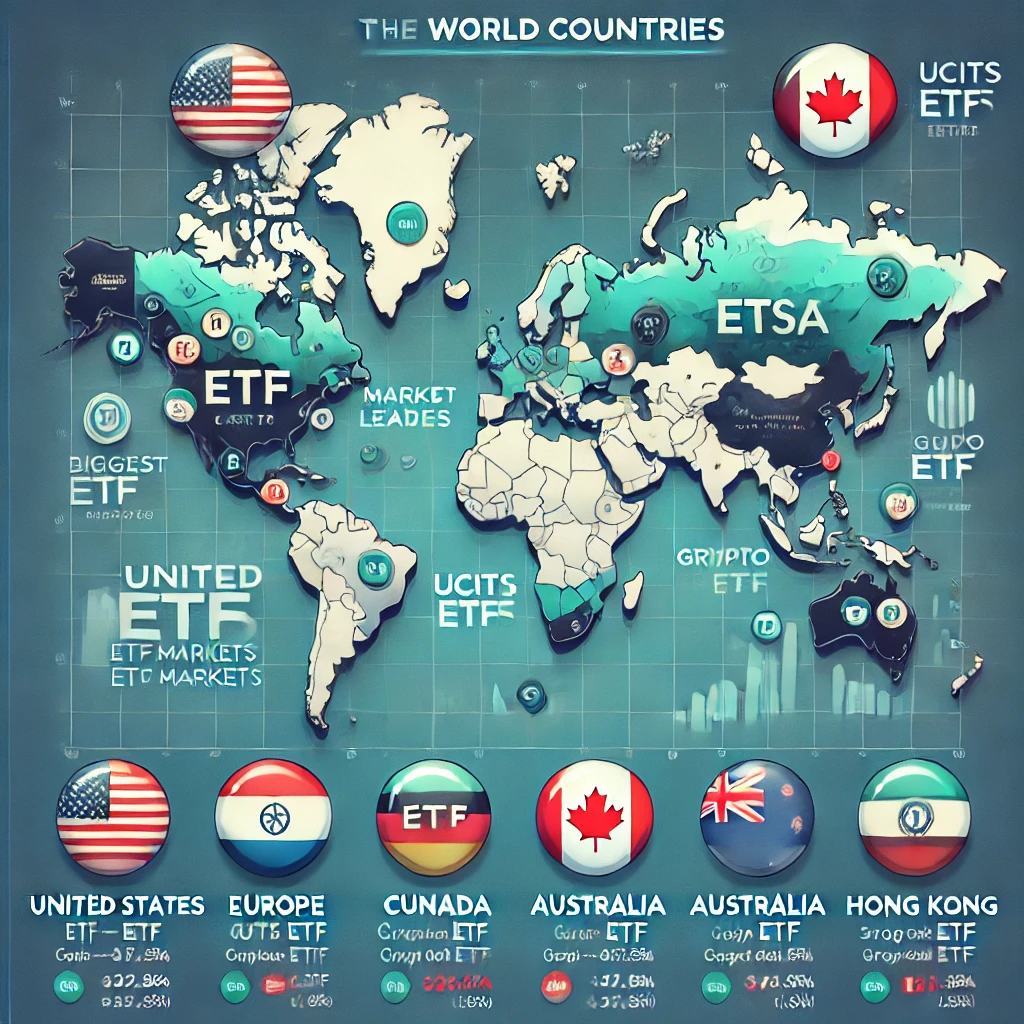
The United Kingdom hosts one of Europe’s largest ETF marketplaces. London Stock Exchange (LSE) listings provide exposure to a broad range of asset classes and geographic regions. However, there are additional considerations for U.K. investors:
- Tax-Efficient Wrappers (ISAs): U.K. investors can hold ETFs within an Individual Savings Account (ISA), shielding capital gains and dividends from taxation up to a certain annual contribution limit.
- Stamp Duty: Unlike individual shares, ETFs typically do not incur U.K. stamp duty.
- U.S.-Listed ETFs Restrictions: U.K. investors generally can’t purchase U.S.-listed ETFs unless they meet specific European regulatory standards (e.g., UCITS compliance).
- UCITS ETFs: UCITS (Undertakings for Collective Investment in Transferable Securities) is an EU directive that ensures funds meet certain investor protection standards. For U.K. residents wishing to track the U.S. markets, a UCITS-compliant ETF often serves as the local solution.
9. Best Practices and Strategies for ETF Investors
Regardless of experience level, these best practices can help optimize your approach to ETF investing:
- Long-Term, Buy-and-Hold
- Ideal for those seeking market-wide growth with minimal daily maintenance.
- Suitable for broad market (e.g., S&P 500) or total-market ETFs.
- Dollar-Cost Averaging (DCA)
- Regularly invest a fixed sum into an ETF, whether prices are high or low.
- Reduces the emotional aspect of market timing and can average out share costs over time.
- Sector Rotation
- Move in and out of specific sector ETFs (technology, healthcare, energy) based on macroeconomic trends or personal forecasts.
- Higher risk and requires close market monitoring.
- Thematic Investing
- Focus on long-term trends (e.g., clean energy, artificial intelligence) using specialized ETFs.
- Beware of higher fees or narrower diversification.
- Hedging and Short-Term Strategies
- Inverse ETFs can help hedge a portfolio against market drops, while leveraged ETFs can amplify gains (and losses).
- Both are more suitable for advanced traders or for short-term, tactical moves.
- Portfolio Rebalancing
- If equity ETFs grow to become an outsized portion of your portfolio, consider adding bond or alternative ETFs to maintain a balanced allocation.
- Revisit allocations yearly or semi-yearly to keep risk in check.
FAQ
What Is the Difference Between an ETF and a Mutual Fund?
Key distinctions lie in trading frequency, tax efficiency, and cost. ETFs trade like stocks throughout the day and often have fewer taxable capital gains distributions. Mutual funds price only once per day (after market close) and can have higher operating costs, although there are many no-load and low-fee mutual funds available as well.
Do ETFs Pay Dividends?
Yes. If the underlying assets (e.g., dividend-paying stocks, coupon-paying bonds) distribute income, the ETF typically passes those payments to shareholders. Some ETFs specifically focus on high-dividend stocks. You can also reinvest these dividends automatically, depending on your broker’s options.
Are ETFs Safe for Beginners?
ETFs are often recommended for beginners because they provide instant diversification, have typically lower fees, and are simpler to trade than a basket of individual stocks. However, no investment is entirely risk-free. Even broad-based ETFs can lose value during market downturns, so it’s essential to understand your risk tolerance.
What Fees Should I Watch Out For?
Expense Ratio: The main annual cost.
Brokerage Commission: Some brokers charge per trade, though many are now commission-free.
Bid-Ask Spread: The gap between buyers’ and sellers’ prices, which can be significant for thinly traded ETFs.
How Much Money Do I Need to Start?
In many cases, you can start with the price of a single share. Some brokers even offer fractional share purchases, allowing you to buy a slice of an ETF with very little capital. The main limitation is any required minimum deposit that your broker might impose.
What Is a Spot Bitcoin ETF?
A spot Bitcoin ETF directly holds bitcoin as its underlying asset. Approved in some jurisdictions starting in 2024, these ETFs let investors gain exposure to bitcoin’s price changes through a traditional brokerage account. This differs from Bitcoin futures ETFs, which invest in futures contracts tied to bitcoin rather than holding the cryptocurrency itself.
How Do Crypto ETFs Fit into a Portfolio?
Like other commodities or alternative assets, crypto ETFs can help diversify a portfolio. However, volatility in digital assets is higher than in many equity or bond markets. Consider your risk tolerance and consult a financial advisor if uncertain.
10. Concluding Remarks
An Exchange-Traded Fund (ETF) offers a flexible, cost-effective means of gaining exposure to a wide range of assets, whether you’re interested in broad market indexes, specific industry sectors, bonds, commodities, currencies, or even cryptocurrencies. Their intraday trading, generally lower fees, and transparency have made ETFs a mainstay in portfolios worldwide.
Before investing, it’s essential to:
- Research an ETF’s underlying holdings, expense ratio, liquidity, and any special features (like leverage or sector focus).
- Evaluate whether the ETF aligns with your risk tolerance and investment goals.
- Consider tax implications, especially if you plan to hold the ETF outside a tax-advantaged account.
- Revisit your portfolio periodically to ensure the ETF still fits your strategy as market conditions evolve.
By incorporating both the breadth of passive and the flexibility of active strategies, ETFs cater to a diverse array of investment styles, from beginners seeking a straightforward, buy-and-hold approach to seasoned traders employing intricate sector rotations, hedges, or leverage. Whether you’re aiming to grow your wealth, generate income, or simply diversify your holdings, ETFs can be a powerful tool in your investment arsenal.
Compare specific ETFs: SPY vs VOO · QQQ vs VOO · VTI vs VXUS · VYM vs SCHD · JEPI vs JEPQ · all ETF comparisons
This article is for educational purposes only and is not investment advice. Investing involves risk, including possible loss of principal, and past performance does not guarantee future results. Consult a qualified financial professional before investing.