New vs Used Car: Which Is the Better Buy?
Figures checked October 28, 2026 against primary sources
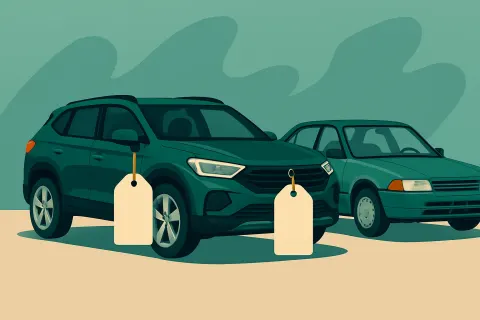
A new car costs far more up front, loses value fastest in its first years and is cheaper to finance. A used car costs less, has already taken the steepest part of the depreciation hit, but comes with higher loan rates, no factory-fresh warranty in many cases, and more risk of hidden problems. Which one is the better buy depends on how you pay, how long you keep cars and how much risk you can absorb. This guide puts real 2026 numbers on each side, from Kelley Blue Book, Cox Automotive, Experian and AAA, and explains the federal rules that protect used-car buyers and the tax break that only new cars get.
The Short Answer
- Used is cheaper to buy: the average used car was listed at $27,239 in August 2026 (Cox Automotive), against $50,089 paid on average for a new one (Kelley Blue Book).
- New is cheaper to borrow for: Experian's average rates in Q2 2026 were 6.35% for new-car loans and 11.19% for used. On a five-year loan, a smaller used-car loan can cost more in interest than a bigger new-car loan.
- Depreciation is the biggest cost of a new car. AAA's 2026 study puts it at $4,422 a year on average for new 2026 models driven 15,000 miles a year, more than insurance, fees and loan interest combined. The CFPB notes that depreciation slows after the first two to three years.
- Only new cars get the car-loan interest deduction (tax years 2025 to 2028, U.S.-assembled vehicles, income limits apply).
- Used-car buyers have federal protections, starting with the FTC Buyers Guide on every dealer car. There is no federal three-day right to cancel.
- Our take: for most budgets the lowest-cost path is a reliable car a few years old, bought with cash or a short loan at a good rate, and kept for a long time.
The Price Gap in 2026
| Measure, August 2026 | New | Used |
|---|---|---|
| Average price | $50,089 paid (transaction price) | $27,239 asked (listing price) |
| Average sticker price | $51,852 | n/a |
| Cheapest mainstream new segment (compact cars) | $27,997 | n/a |
The headline gap is about $22,850, but the averages compare different things: the new figure is what buyers actually paid across every segment, pickups and luxury SUVs included, while the used figure is the asking price on dealer lots. The more useful comparison is the specific car you want. A new compact car averaged $27,997, about the same as the average used listing, so a buyer choosing between a new small sedan and a three-year-old midsize SUV may be looking at similar prices.
Financing: Used Cars Cost More to Borrow For
| Experian, Q2 2026 | New | Used |
|---|---|---|
| Average interest rate | 6.35% | 11.19% |
| Average amount financed | $43,610 | $27,852 |
| Average monthly payment | $765 | $542 |
The gap is large: almost 5 percentage points on average. New cars also get promotional financing that used cars rarely see; the FTC says dealers sometimes offer manufacturer-sponsored low-rate or incentive programs, which may be limited to certain cars, require a strong credit rating, or come with a larger down payment or a shorter contract.
Two ways to narrow the gap: get pre-approved at a credit union or bank before you shop (the FTC recommends getting credit terms in advance so you can negotiate), and keep the loan short. Compare current offers on our auto loan rates page.
Worked Example: Total Cost Over Five Years
Assumptions (hypothetical): a new compact car for $28,000 and a used car for $20,000, $3,000 down on each, a 60-month loan at Experian's Q2 2026 average rate for each type, and no taxes or fees.
| New, 6.35% | Used, 11.19% | Used, 6.35% (good rate) | |
|---|---|---|---|
| Price | $28,000 | $20,000 | $20,000 |
| Amount financed | $25,000 | $17,000 | $17,000 |
| Monthly payment | $487.40 | $371.23 | $331.43 |
| Total interest | $4,244 | $5,274 | $2,886 |
| Total paid (down payment + loan) | $32,244 | $25,274 | $22,886 |
- The used car still costs about $7,000 less in total, even at the average used rate.
- But it costs about $1,030 more in interest than the new-car loan, despite borrowing $8,000 less. The rate matters as much as the price.
- Getting the new-car rate on the used car cuts its interest by about $2,390. That is the value of shopping for a loan before you shop for a car.
The new car's extra cost is partly offset by what it is worth at the end, since you will own a newer car when the loan is paid off. Whether that offset is big enough depends on depreciation, below. Try your own numbers in the auto loan calculator or see what price fits your budget with the car affordability calculator.
Depreciation: The Biggest Cost of a New Car
AAA's Your Driving Costs study prices out the full cost of owning a new car each year, averaging five top-selling 2026 models in each category. Its 2026 weighted average for a car driven 15,000 miles a year:
| AAA 2026, new car, 15,000 miles a year | Per year |
|---|---|
| Depreciation | $4,422 |
| Full-coverage insurance | $2,098 |
| Finance charges | $1,184 |
| License, registration, taxes | $802 |
| Ownership costs subtotal | $8,506 |
| Fuel and maintenance (29.04¢ a mile) | $4,356 |
| Total | $12,863 |
Depreciation is more than a third of the total and more than insurance, fees and loan interest combined. AAA found it is even larger for the electric models it compared: $5,298 to $8,624 a year, against $3,330 to $6,446 for their gas versions.
The timing matters too. The CFPB notes that a new car's value drops sharply the moment you take ownership, and that depreciation slows after the first two to three years. That is the core case for buying used: a car two or three years old has already absorbed the steepest drop, and you pay for the slower part of the curve. It is also why a new car bought with little money down can quickly leave you "upside down," owing more than the car is worth; see our guide to an upside-down car loan.
The New-Car Loan Interest Deduction
The 2025 tax law (Public Law 119-21) added a deduction for car-loan interest that only new cars can use:
- Years: tax years 2025 through 2028, for loans taken out after December 31, 2024, secured by a first lien on the vehicle.
- Vehicles: the original use must start with you, so used cars don't qualify. It must be a car, minivan, van, SUV, pickup or motorcycle under 14,000 pounds, with final assembly in the United States, bought for personal use. Lease financing doesn't qualify.
- Limit: up to $10,000 of interest a year, reduced by $200 for each $1,000 of modified AGI above $100,000 ($200,000 on a joint return). You must report the VIN on your return.
The deduction lowers taxable income, not tax directly. In the worked example, the new car's first-year interest is about $1,460; at a 22% tax bracket the deduction would be worth about $320 that year (our arithmetic). Helpful, but not enough on its own to make a new car the cheaper choice.
Buying Used: The Buyers Guide and Your Rights
The FTC's Used Car Rule (16 CFR part 455) requires dealers to post a Buyers Guide on every used vehicle they offer for sale, and the FTC says you are also entitled to one if you buy a used car online. It tells you:
- whether the car is sold "As Is - No Dealer Warranty", with implied warranties only, or with a dealer warranty, and what share of repair costs the dealer will pay;
- the major mechanical and electrical systems and some problems to look out for;
- to get all promises in writing, ask for an independent inspection, and get a vehicle history report.
Three rules worth knowing:
- The Buyers Guide is part of your contract and overrides anything in the contract that contradicts it (16 CFR 455.3). If the Guide promises a warranty and the contract says "as is," the FTC says the dealer must honor the warranty.
- "As is" means you bear the repair risk. Without an as-is sale, implied warranties still apply; the FTC says implied warranty coverage can last up to four years, depending on the state. Some states limit or ban as-is sales of cars.
- There is no federal three-day cooling-off period. The FTC says federal law doesn't require dealers to let you cancel and return the car; some states or dealers offer it. Ask for the return policy in writing before you buy.
Before you buy, pay for an independent mechanical inspection. The FTC notes that a vehicle history report may list accidents and flood damage but typically won't list mechanical problems, and is not a substitute for an inspection. The rule covers dealers, defined as anyone who sold or offered five or more used vehicles in the previous 12 months, so a typical private seller doesn't have to post a Buyers Guide. Get any promises from a private seller in writing.
Certified Pre-Owned: The Middle Ground
"Certified pre-owned" (CPO) cars are used cars that a dealer or carmaker has inspected and often backs with an extra warranty. What "certified" includes depends on the program, so read what you are paying for: who issues the warranty (the manufacturer or the dealer), how long it lasts and what it covers, and compare the price with similar non-certified cars.
- If a manufacturer's original or used-vehicle warranty applies, the dealer can say so on the Buyers Guide; ask for the warranty documents and check the expiration date or mileage with a dealer using the VIN.
- The FTC says an independent inspection is a good idea even if the car is "certified" and was inspected by the dealer.
- An extended warranty sold on top of a CPO car is usually a service contract, not a warranty. See is an extended car warranty worth it before you add one.
How to Buy a Car With Cash
Paying in full is the simplest way to avoid interest: the FTC notes that financing increases the total cost of a car because you also pay for credit. In the worked example, cash saves the $4,244 of interest on the new car and $5,274 on the used one. Steps:
- Set the budget from your savings, not the other way round. Keep your emergency fund intact; a car bought by draining it can push the next repair onto a credit card.
- Get an "out-the-door" price in writing from several dealers before you visit, as the FTC recommends: the total price including taxes and fees. Don't assume advertised rebates are already included.
- Settle the price as its own deal. The FTC notes that dealers typically profit from arranging financing and may not always offer you the best deal, so agree on the out-the-door price first and treat any financing offer as a separate decision.
- Check the incentives anyway. The FTC says manufacturer incentives can be lower finance rates or cash back on certain makes or models. If a 0% or near-0% loan is offered, taking it and keeping your cash in savings can beat paying cash; if the alternative is a cash rebate, compare the rebate with the interest you would pay.
- Pay with a cashier's check or a bank wire, not a bag of bills. Ask the dealer how it wants to be paid and confirm wire instructions by phone with a known number before sending money.
- Get the title, bill of sale and Buyers Guide (for a used car), and register the car with your state.
About the $10,000 reporting rule: a business that receives more than $10,000 in cash in one transaction must file IRS/FinCEN Form 8300 and send you a written notice. Cash here means currency, plus cashier's checks, money orders and similar instruments of $10,000 or less in some cases. The IRS's own examples say a single cashier's check over $10,000, or a bank wire, is not cash for this purpose. The form is routine; it is not a tax on you.
Cash vs a loan in one line: if your savings earn less after tax than the loan's interest rate, paying cash saves money. If the loan rate is promotional and very low, borrowing and keeping your savings invested can come out ahead, as long as the payment fits comfortably in your budget.
New or Used: How to Decide
| New may make sense if... | Used may make sense if... |
|---|---|
| You will keep the car for many years, so the early depreciation is spread over a long life | You replace cars every few years, so avoiding the first years' depreciation matters most |
| You qualify for a promotional rate or the interest deduction | You are paying cash, or can get a credit-union rate close to new-car rates |
| You want a full factory warranty and the newest safety features | You can pay for an independent inspection and handle a repair bill |
| The used version of the model you want costs almost as much as new | A model a few years old meets your needs at a much lower price |
Whichever you choose, don't forget the running costs: insurance, fuel, parking and maintenance. Our commute cost calculator shows what the daily drive adds, and average car insurance cost covers the premium side.
Sources & Methodology
- Kelley Blue Book Average Transaction Price, August 2026 and Cox Automotive used-vehicle inventory, August 2026, as compiled on our average car price page (facts checked 2026-10-08).
- Experian, State of the Automotive Finance Market, Q2 2026: rates, amounts financed and payments, as reported on our average car payment page.
- AAA, Your Driving Costs 2026 (PDF): depreciation and ownership costs.
- CFPB, Negative Equity Findings from the Auto Finance Data Pilot (June 2024): depreciation pattern.
- Public Law 119-21, section 70203: car-loan interest deduction (26 U.S.C. 163(h)(4)).
- 16 CFR part 455, FTC Used Motor Vehicle Trade Regulation Rule and FTC, Buying a Used Car From a Dealer.
- FTC, Financing or Leasing a Car: out-the-door price, dealer financing, incentives.
- IRS, Form 8300 Reference Guide.
The new and used averages measure different things (transaction price vs listing price) and are not a like-for-like comparison. We did not quote a percentage depreciation rate (such as "20% in the first year") because we found no primary dataset that publishes one; AAA's dollar estimate is used instead. The worked example is hypothetical and leaves out taxes, fees, insurance and resale value.
FAQ
Is it better to buy a new or used car?
For most budgets, a reliable used car a few years old costs less overall, because it has already taken the steepest part of the depreciation, which the CFPB says comes in the first two to three years. New can make sense if you keep cars a very long time, qualify for a low promotional rate, or the used version costs nearly as much as new.
How much cheaper is a used car?
In August 2026 the average used car was listed at $27,239, against $50,089 paid on average for a new one. The gap for a specific model is usually much smaller than the averages suggest.
How much higher are used car loan rates?
Experian's Q2 2026 averages were 6.35% for new-car loans and 11.19% for used, a gap of almost 5 percentage points. Your own rate depends on your credit and the lender, so get a pre-approval from a credit union or bank and compare it with the dealer's offer.
Can I buy a car with cash at a dealership?
Yes. You can pay with a cashier's check or a bank wire; ask the dealer which it accepts. If a dealer receives more than $10,000 in actual currency, it must file IRS Form 8300 and tell you it did.
Do dealers give better prices if you finance?
Some advertised discounts and rebates come with conditions, and the FTC says dealers that promote them must clearly explain what's required to qualify. Ask for the out-the-door price in writing, ask whether any discount depends on financing, and compare the total cost both ways.
Is a certified pre-owned car worth it?
It can be if the certification includes a manufacturer warranty that covers what you care about and the price premium is modest. Still get an independent inspection, as the FTC advises.
Does the car loan interest deduction apply to used cars?
No. The vehicle's original use must begin with you, so only new vehicles qualify, and final assembly must be in the United States.
This article is for general information and is not financial or tax advice. Prices are August 2026 figures from Kelley Blue Book and Cox Automotive; rates are Experian Q2 2026 averages; ownership costs are from AAA's Your Driving Costs 2026; rules are from the FTC, IRS and federal law, all read on 2026-10-27 or as noted. The worked example is hypothetical. Your price, rate and costs will differ.