Debt Avalanche vs. Debt Snowball: Which Strategy Is Better?
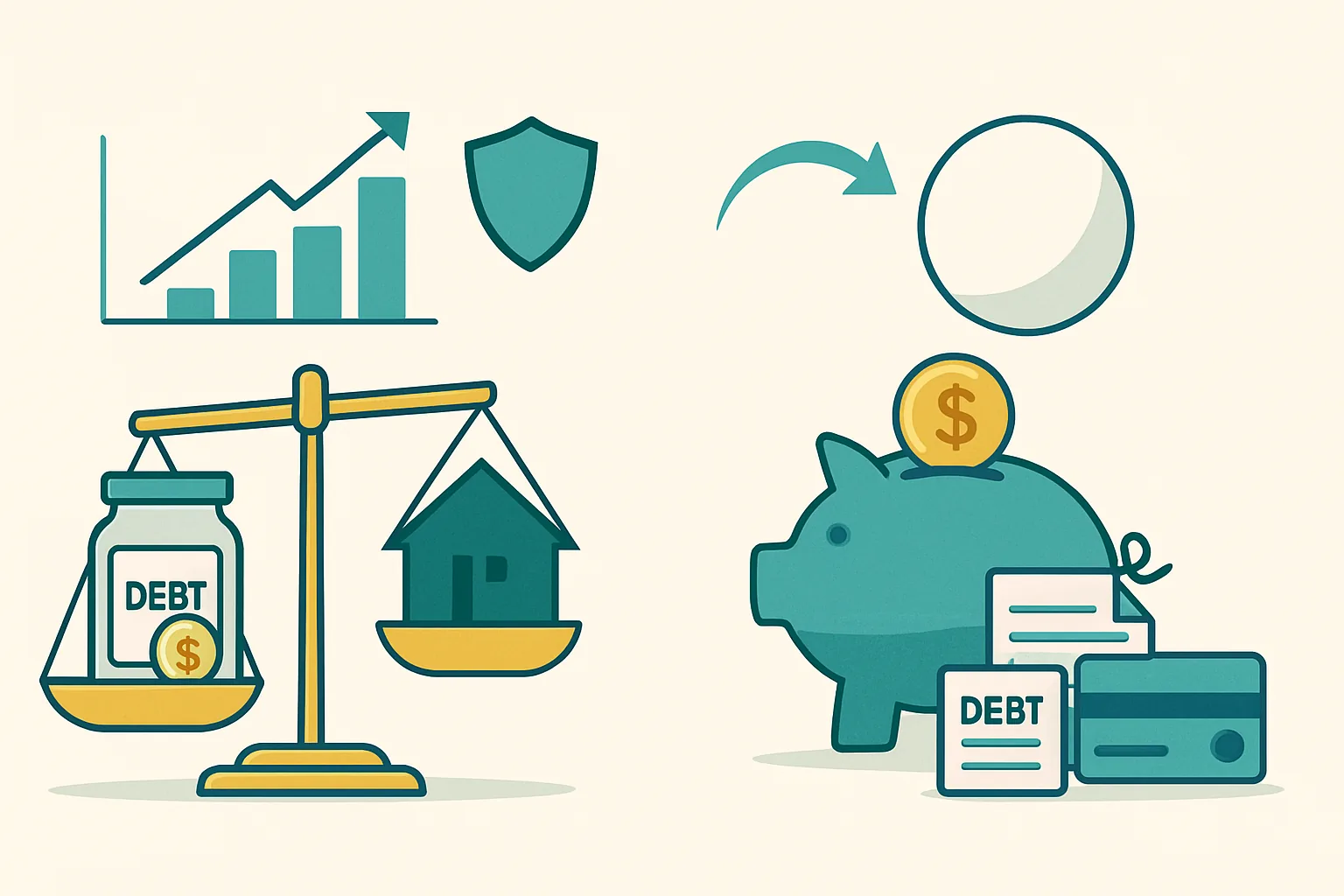
The debt snowball and the debt avalanche are two ways to decide which debt gets your extra money first. Both pay the minimum on everything and throw every spare dollar at one target debt; when it is gone, its payment rolls into the next. The only difference is the order: the snowball goes smallest balance first, the avalanche goes highest interest rate first. Enter your own debts below to see what that difference is worth for you.
The Short Answer
- The avalanche always costs the least interest (or ties), because the most expensive debt shrinks first.
- The snowball clears whole accounts sooner, and a study of real debt-settlement clients found that closing accounts, not the dollars paid off, was what predicted getting out of debt.
- The gap is often small. In our example below it is $306 and one month over two and a half years. If the smallest debts also carry the highest rates, both methods pick the same order.
- The method matters less than the extra payment. Adding $300 a month to the minimums in the same example saves more than $3,400 of interest either way.
Debt Snowball vs Avalanche Calculator
Add each debt with its balance, interest rate (APR) and minimum payment, then the extra amount you can pay each month on top of the minimums. The calculator runs both orders month by month and shows how long each takes and how much interest each costs.
It assumes fixed rates and no new charges, and that you keep paying the same total each month: when a debt is paid off, its minimum payment moves to the next target. That rollover is what makes both methods speed up over time.
How Each Method Works
| Debt snowball | Debt avalanche | |
|---|---|---|
| Extra money goes to | The smallest balance | The highest interest rate |
| Strength | First accounts disappear fast; fewer bills to track | Lowest total interest, usually the fastest finish |
| Weakness | Can cost more interest if a big balance carries a high rate | The first win can take many months if the costliest debt is large |
| Best when | You have several small balances or need visible progress to keep going | One debt's rate is far above the rest, or the balances are similar |
Both methods work the same way in every other respect:
- List every debt with its balance, rate and minimum payment.
- Pay the minimum on all of them, every month, on time.
- Send every extra dollar to the target debt.
- When the target is paid off, add its whole payment to the next target. Keep the total you pay each month the same until everything is gone.
Same Debts, Both Methods
Hypothetical example, calculated with the same engine as the calculator above. Four debts totaling $24,600, with $680 a month of minimum payments plus $300 a month extra ($980 a month in total):
| Debt | Balance | APR | Minimum | Paid off (snowball) | Paid off (avalanche) |
|---|---|---|---|---|---|
| Store card | $900 | 28.9% | $35 | Month 3 | Month 3 |
| Personal loan | $3,200 | 12% | $110 | Month 10 | Month 20 |
| Credit card | $6,500 | 23.9% | $195 | Month 20 | Month 17 |
| Car loan | $14,000 | 7.5% | $340 | Month 30 | Month 29 |
| Total interest | $3,825 | $3,519 | |||
The avalanche finishes one month sooner and costs $306 less, because the 23.9% credit card shrinks before the 12% loan. The snowball clears its second account in month 10 instead of month 20. Here the store card is both the smallest and the most expensive debt, so both methods start with it.
Paying only the minimums in this example (still rolling each paid-off minimum into the next debt) takes 47 months and $7,314 of interest. The $300 extra is worth more than the choice of method.
What the Research Says
The best-known study is by David Gal and Blakeley McShane of Northwestern University's Kellogg School, published in the Journal of Marketing Research in 2012 (vol. 49, no. 4, pp. 487-501). Using records from a debt settlement company, they found that closing debt accounts predicted eliminating debt regardless of the dollar balance of the accounts closed, while the dollars paid off did not predict it once the share of accounts closed was taken into account. Their reading: finishing discrete subtasks keeps people going.
That supports the snowball's logic, with two limits. The data came from people in a debt settlement program, not from everyone paying down debt. And it is about what keeps people motivated, not about cost: on interest alone, the avalanche wins or ties every time.
Which One to Choose
- Run your numbers first. If the calculator shows a small gap, pick the snowball if quick wins help you; you lose little.
- Pick the avalanche when one rate stands far above the rest and its balance is not huge. The interest saved can be large.
- Pick the snowball when you have many small balances. Each one you clear is one less due date to miss and one less minimum payment in your budget.
- A hybrid is fine. Knock out one or two tiny balances for momentum, then switch to the highest rate.
Whichever you choose, fewer debt payments also lower your debt-to-income ratio, which matters when you next apply for a mortgage or car loan.
Debts That Need a Different Rule
- 0% promotional balances. A balance-transfer or 0% purchase balance costs nothing until the promotion ends. Under the avalanche it goes last, but check the end date: if you cannot clear it in time, the regular rate applies to what is left. Some deferred-interest store offers charge back-interest from the purchase date; read the terms.
- Federal student loans. If you expect forgiveness through Public Service Loan Forgiveness or an income-driven plan, paying them early may waste money that will be forgiven anyway. See student loan forgiveness before putting them in either queue.
- Your mortgage. Most people leave it out of the payoff list: it is usually the largest balance and among the lowest rates. Whether to pay it off early is a separate question; see pay off the mortgage or invest.
- Debts in collections or past due. These follow their own rules, including deadlines and lawsuits, and can be worth handling first. A nonprofit credit counselor can help you sort them.
- No emergency savings. Without a small cash cushion, the next car repair goes back on a card. Many plans keep a starter emergency fund before sending extra to debt; see how to build an emergency fund.
Making Either Method Work
- Find the extra money. A written budget is where it comes from; the 50/30/20 rule or a zero-based budget are simple starting points.
- Stop adding new debt to the accounts you are paying down. Otherwise the balances refill as fast as you pay.
- Ask for a lower rate. A lower APR helps under either method; see how to lower the interest rate on your loans and whether consolidation would save money.
- Automate the minimums so a missed payment never adds a late fee, then send the extra by hand each payday.
- Re-run the calculator when a balance, rate or your income changes.
FAQ
What is the difference between the debt snowball and the debt avalanche?
Only the order. The snowball sends your extra payment to the smallest balance first; the avalanche sends it to the highest interest rate first. Both pay minimums on everything else and roll each paid-off payment into the next debt.
Which is faster, snowball or avalanche?
The avalanche usually finishes the same month or sooner and always costs the same or less interest. The snowball pays off individual accounts sooner, which is a different kind of "faster." In our example the avalanche finished one month earlier and saved $306.
Does the debt snowball actually work?
A 2012 study of debt settlement clients found that people who closed more of their accounts were more likely to eliminate their debt, whatever the size of those accounts. That supports the snowball's focus on quick wins, though the study did not compare the two methods directly.
Should I include my mortgage or car loan?
Car loans and other installment loans usually go on the list. Most people leave the mortgage out and decide separately whether to pay it off early.
What if two debts have the same balance or rate?
Either order works. A common tie-breaker for the snowball is the higher rate; for the avalanche, the smaller balance.
How do I calculate a debt snowball?
List your debts from smallest to largest balance, pay minimums on all, put every extra dollar on the smallest, and add each freed-up payment to the next. The calculator above does the month-by-month math for both orders.
This article is for general information and is not financial advice. The example is hypothetical and calculated with fixed rates and no new charges. Research citation checked against the published abstract on 2026-10-27. If your debts are unmanageable, consider a nonprofit credit counselor.