Cash Envelope System: How It Works, Which Envelopes to Use, and the Digital Version
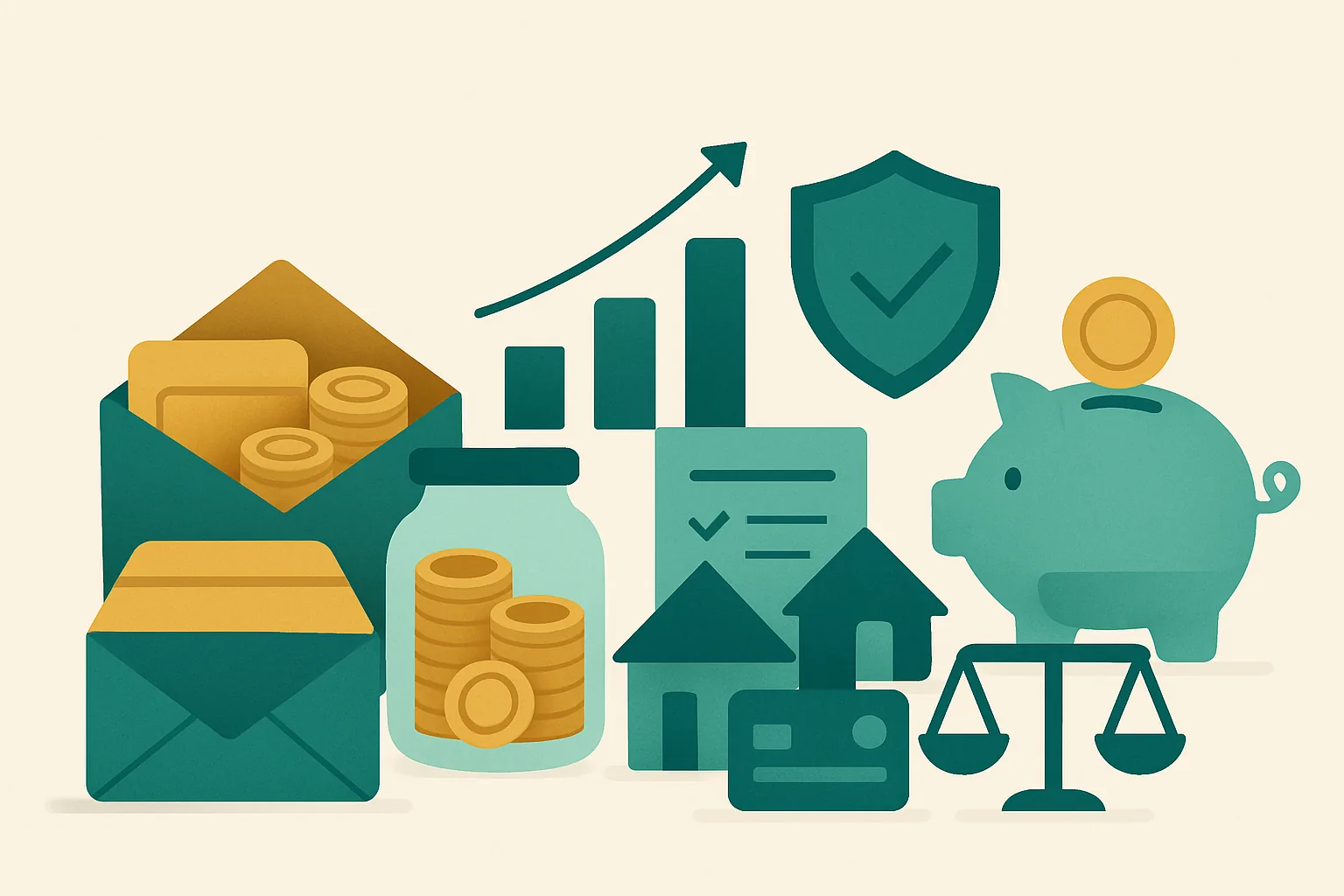
The cash envelope system is a budgeting method where you take the money for your flexible spending (groceries, fuel, eating out, fun) out of the bank as cash at the start of the month or pay period and split it into labeled envelopes. When an envelope is empty, spending in that category stops until the next refill. It works because it makes overspending physically impossible, not just discouraged. Below is how to set it up, which categories belong in cash, a worked month, and how to run the same system without cash.
The Short Answer
- Only flexible spending goes in envelopes. Rent, utilities, insurance and debt payments stay on autopay from your bank account.
- Fill the envelopes on payday with the amounts from your budget, and spend only from them.
- Empty means stop. You can move cash from one envelope to another on purpose, but never top up from the card.
- It still works, even though cash was only 14% of US payments in 2024 (Federal Reserve). Most people use cash for a few problem categories and a card for the rest.
- The digital version (an envelope app or named savings buckets at your bank) keeps the rules without carrying cash.
How the Envelope System Works
- Make a monthly budget first. Start from take-home pay and list every bill, savings goal and spending category. The envelope system is how you stick to the flexible part of that plan; the zero-based budget worksheet is a good way to build it.
- Pick the envelope categories (see the next section) and the amount for each.
- Split by pay period. If you are paid every two weeks, fill half of each monthly amount per paycheck. Smaller amounts are easier to manage and safer to carry.
- Withdraw the cash on payday in small bills, so you can pay exact amounts and keep change in the right envelope.
- Spend only from the envelope for that category, and keep the receipt inside it.
- At the end of the period, decide what to do with leftovers: roll them over, move them to savings, or put them toward debt.
Which Categories Go in Envelopes
| Good in cash | Keep on autopay or card |
|---|---|
| Groceries | Rent or mortgage |
| Eating out and takeout | Utilities, phone, internet |
| Fuel (if your station takes cash) | Insurance premiums |
| Entertainment and hobbies | Loan and credit card payments |
| Personal care and clothing | Subscriptions (or cancel them) |
| Household supplies | Savings and retirement transfers |
| Gifts and kids' activities | Online purchases |
| Each adult's personal spending money | Large irregular bills (pay from a sinking fund account) |
Start with the two or three categories where you overspend most. Five to eight envelopes is enough for most households; twenty is hard to keep up.
A Worked Month
A hypothetical household brings home $4,800 a month, paid every two weeks. Fixed bills ($2,950) and savings ($550) stay in the bank. The remaining $1,300 of flexible spending goes into six envelopes, filled in two halves:
| Envelope | Monthly | Per paycheck |
|---|---|---|
| Groceries | $600 | $300 |
| Eating out | $150 | $75 |
| Fuel | $200 | $100 |
| Household and personal care | $120 | $60 |
| Entertainment | $100 | $50 |
| Personal money (two adults) | $130 | $65 |
| Total cash | $1,300 | $650 |
By day 10 the eating-out envelope is empty. Two choices: no more takeout until the next payday, or move $30 from entertainment on purpose. What is not allowed is paying with a card "just this once": that is the leak the system exists to close. At month end $45 is left in groceries; it goes to the emergency fund.
The Rules That Make It Work
- No borrowing from the card. If an envelope runs out, the category is done until refill day.
- Moves between envelopes are allowed but deliberate. Write the move on both envelopes so you can see the pattern next month.
- Carry only what you need. Take the grocery envelope to the store and leave the rest at home in a safe place.
- Keep the emergency fund out of the envelopes. It belongs in an insured savings account, not in cash at home.
- Adjust after two or three months. If an envelope is always empty by week three, the budget amount is wrong, not you. Raise it and cut somewhere else.
Does It Still Work When Few People Pay Cash?
Cash is now a minority payment method. In the Federal Reserve's 2025 Diary of Consumer Payment Choice, cash accounted for 14% of all payments in 2024 and was used most for purchases under $25, while credit cards made up 35%. Some places do not take cash at all, and you give up card rewards on whatever you pay in cash.
The method still works because the point was never the paper money. It is the hard limit: a fixed amount per category that cannot be exceeded without a deliberate decision. Cash enforces that limit physically. Cards make it easy to spend past a limit you cannot see, which is why many people who struggle with a budget do better with cash for their two or three worst categories, even if everything else stays digital.
If you carry a credit card balance, rewards do not matter: card interest averaged 22.15% on accounts charged interest in the second quarter of 2026 (Federal Reserve G.19), far more than any cash-back rate.
Digital Envelopes: Apps and Bank Buckets
You can run the same rules without cash. Three ways:
- Envelope budgeting apps. Goodbudget is built around envelopes and has a free plan (10 regular and 10 annual envelopes, one account, two devices); Premium is $10 a month or $80 a year. YNAB assigns every dollar to a category and costs $14.99 a month or $109 a year after a 34-day trial. EveryDollar's manual version is free; its Premium tier with bank connection is $17.99 a month or $79.99 a year. Prices as checked for our budgeting app comparison on October 18, 2026, and re-checked on the vendors' pages on October 30, 2026.
- Bank savings buckets. Many banks let you split one savings account into named goals or open several free accounts. Move each envelope's amount into its own bucket on payday and pay from it. Deposits at an FDIC-insured bank are insured up to $250,000 per depositor, per bank, for each ownership category, so splitting money into buckets at the same bank does not raise or lower your coverage.
- A dedicated debit card. Keep a separate checking account for flexible spending only, load it on payday with the envelope total, and use that card for those categories. When it is empty, you are done.
The digital version is easier to keep up and safer than cash. The trade-off is that the limit is softer: a card always works until the account is empty, so it depends more on checking the app before you buy.
Pros and Cons
| Pros | Cons |
|---|---|
| Overspending stops at a hard limit | Cash can be lost or stolen and is not insured |
| You see how much is left at a glance | Some stores and most online shops do not take cash |
| No app, account or fee needed | No card rewards or purchase protection |
| Works well for couples: each envelope is visible to both | Takes time: withdrawals, receipts, refills |
FAQ
What is the cash envelope system?
A budgeting method where you put the cash for each flexible spending category into its own envelope on payday and spend only from that envelope until the next refill.
What categories should I use for cash envelopes?
Flexible spending: groceries, eating out, fuel, entertainment, household and personal care, gifts, and personal money. Keep fixed bills, debt payments and savings on autopay.
Does the envelope system really work?
It works for people whose problem is overspending in a few categories, because it sets a hard limit. It does not fix a budget that is short on paper; build the plan first.
Can I do the envelope system without cash?
Yes. Use an envelope budgeting app, named savings buckets at your bank, or a separate debit card loaded with the envelope total each payday.
What do I do with money left in an envelope?
Decide in advance: roll it into next month's envelope, move it to savings, or put it toward debt. Moving leftovers to savings is the most common choice.
Is it safe to keep budget cash at home?
Cash at home is not insured if it is lost or stolen. Keep only the current pay period's envelopes at home and the rest in an insured account.
Sources: Federal Reserve Financial Services, 2025 Findings from the Diary of Consumer Payment Choice (cash and credit card shares of payments in 2024, cash use under $25), retrieved October 30, 2026. Federal Reserve Board, G.19 Consumer Credit release of October 7, 2026 (interest rate on credit card plans, accounts assessed interest, second quarter of 2026), retrieved October 30, 2026. FDIC, Understanding Deposit Insurance, retrieved October 30, 2026. App prices from the Goodbudget plans page, the YNAB pricing page and the EveryDollar page, re-checked October 30, 2026.
This article is for general information and is not financial advice. Cash-use figures are from the Federal Reserve's 2025 Diary of Consumer Payment Choice; the card rate from the Federal Reserve G.19 (Q2 2026); the FDIC limit from fdic.gov (checked 2026-10-30); app prices from the vendors' pages as checked on 2026-10-30. The worked month is hypothetical.